
How we closed the loop between the user, their motorcycle, and the Honda workshop — turning passive data into a proactive experience.
We didn’t start from an internal hypothesis. Two independent data sources were pointing in the same direction: there was a massive activation gap in the maintenance flow, and users were asking for help managing it
Honda handles 40,000 service visits per year across its dealer network in Spain. Only 20% are booked through the app, despite 95% of current Honda motorcycles coming with Mapit pre-installed from the factory.
A satisfaction survey sent at the 4-month mark after sign-up revealed explicit interest in receiving service reminders inside the app. Users were asking for it — the app just wasn’t delivering.
Before designing anything, we needed to understand how users actually relate to service workshops: when and how they manage their maintenance, what creates friction, and what they expect from the app. We ran a survey completed by 450 users.
Research sample
Users completed the survey on their maintenance behaviours and habits
Dominant pattern
Most users deal with maintenance only when something breaks down or the workshop calls them
Main friction
There’s no personal system to track when the next service is due — it just slips through
The research confirmed what we suspected: maintenance is a recurring and predictable behaviour, but users experience it as something vague and dateless. There’s no clear activation moment — and the app had zero role in that cycle
Maintenance is cyclical by nature. If we can make the app a natural part of that cycle, every service visit becomes a user reactivation touchpoint — and a business opportunity for the workshop. The potential impact goes well beyond UX:
Real value to the user: proactive, relevant information about their motorcycle with zero extra effort on their part.
Business growth for Honda dealers: more appointments managed through the digital channel, with full traceability.
Mapit’s positioning: cementing the app as a key partner in Honda’s business — not just a motorbike accessory.
On the first draft, the feature included two types of reminders: one based on time counted since the last service, and one based on mileage. The logic made sense on paper — Honda recommends servicing their bikes every 12 months or every 6,000 or 12,000 km (depending on the model), whichever comes first.
Day 0
newly purchased motorbike
Initial service
at 1,000km
Subsequent services
yearly or every 6,000/12,000km
the first to happen
Ignoring the mileage dimension felt like delivering only half the solution. But after an alignment session with the engineering team, we had to make a difficult call: we dropped mileage-based alerts entirely.
The reason was simple but critical. Mapit calculates mileage by aggregating the trips a user records through the app. That figure carries an inherent and uncontrollable deviation — users don’t always have the app running, trips get missed, and there’s no way to reconcile our estimate against the motorcycle’s actual odometer. In practice, the gap between what Mapit shows and what the dashboard reads can be significant
Shipping alerts based on that number would have meant sending notifications to users who may have already passed that threshold weeks ago or who still have hundreds or thousands of km to go. Either way, a wrong alert.
The decision wasn’t just about accuracy. It was about trust. A feature built around proactive reminders only works if users believe those reminders are reliable
Before designing the first wireframe, we had to confront an uncomfortable reality in our own dataset. To remind users about their next service, we first needed to know when their last one took place — and for 70% of our users, we had no record of that whatsoever.
Only 30% of users had any maintenance record in the app — and within that 30%, most entries were over a year old, likely not reflecting the user’s actual last service
For the remaining 70% we had absolutely nothing. Designing around that void required a solution that was useful even without prior history.
To address this, I designed a feature onboarding with three distinct paths. Each flow was tailored to what we already knew about the user — whether they had a recent service logged, outdated records, or no history at all. That way, we could collect exactly the missing piece of information for each case, and use it to generate an accurate forecast of their next service.
Odometer < 1,000 km or has a requested appointment (regardless of km) -> we only show the feature information, they will soon go to their next appointment, and we will have the information needed to calculate their next service interval
Odometer ≥ 1,000 km + has at least 1 maintenance record -> we ask them to confirm whether the recorded maintenance is actually their most recent one, and if not, prompt them to enter their actual last maintenance
Odometer ≥ 1,000 km + no maintenance record -> we directly prompt them to enter their last maintenance
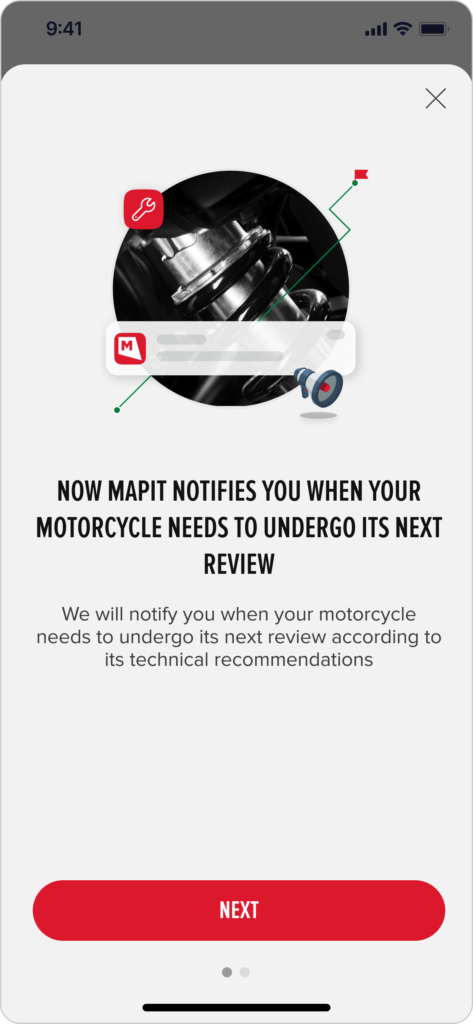
Feature information
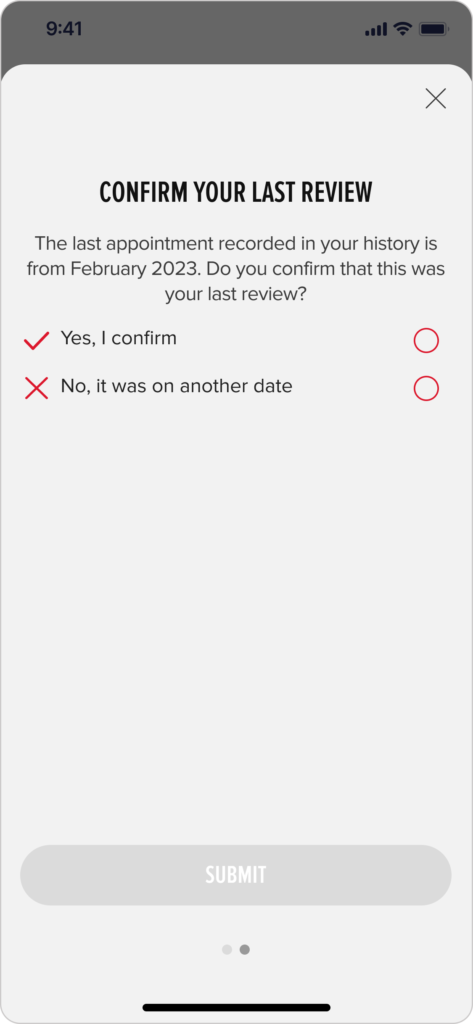
Confirm your last service
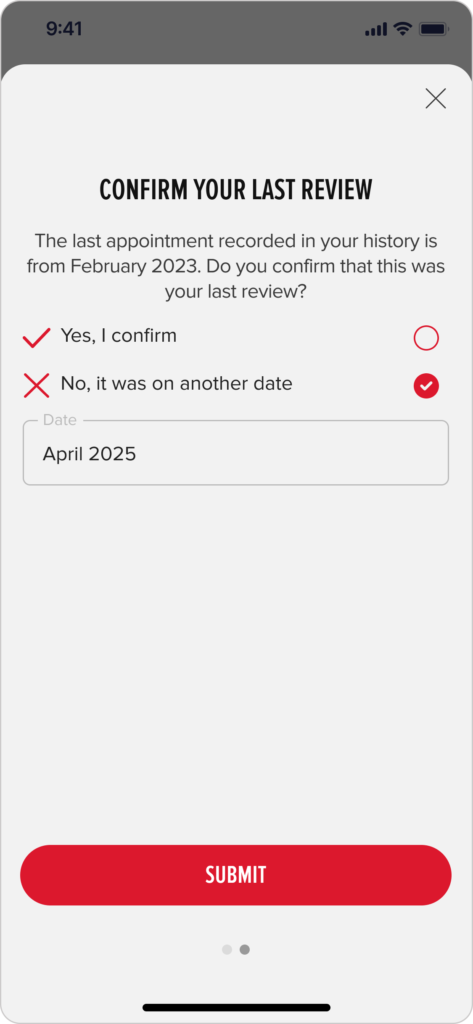
Set your last service
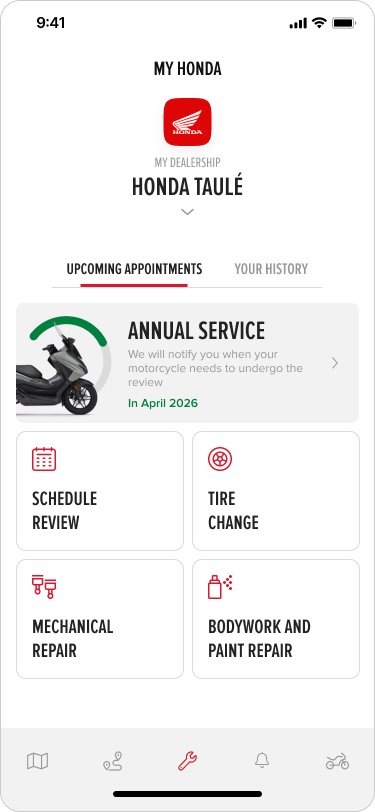
We calculate your next service
The system was built around the date of the last recorded service (or the motorbike’s purchase date as a baseline when no history exists) to project the next recommended service. The experience guides users to complete their history and, from that point, generates an automatic reminder cycle with a direct option to book an appointment from the notification itself.
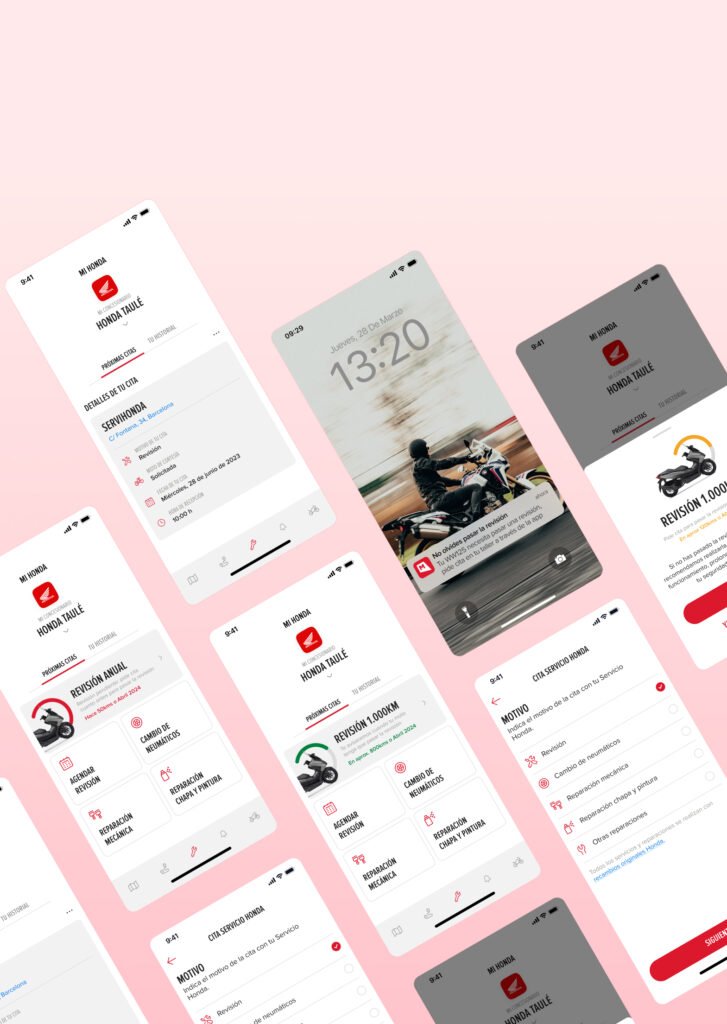
The maintenance card acts as the feature’s main touchpoint — always visible, always up to date. It communicates the motorbike’s service status through three colour-coded states.
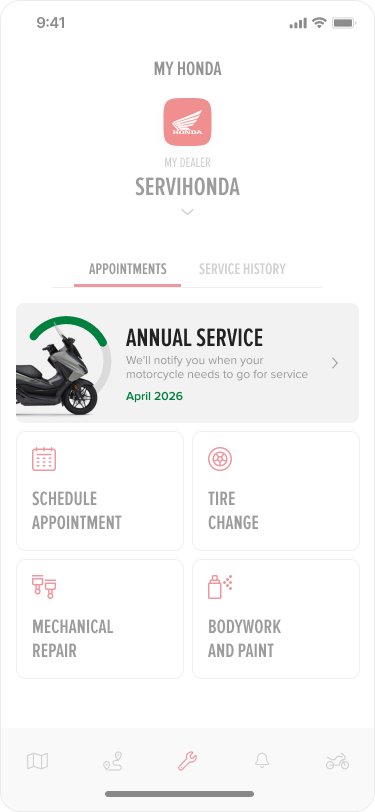
When everything is on track and the next service is still comfortably ahead, the card displays a green progress arc with a reassuring message, letting the user know the app is keeping an eye on things.
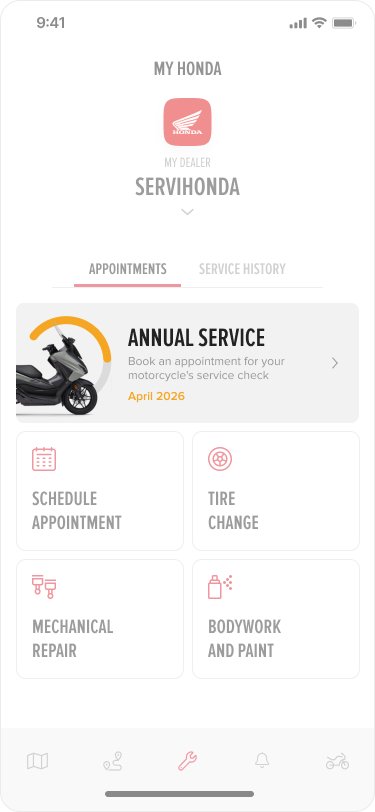
As the due date approaches, the card shifts to yellow — the arc tightens and the copy becomes more direct, prompting the user to start thinking about booking.
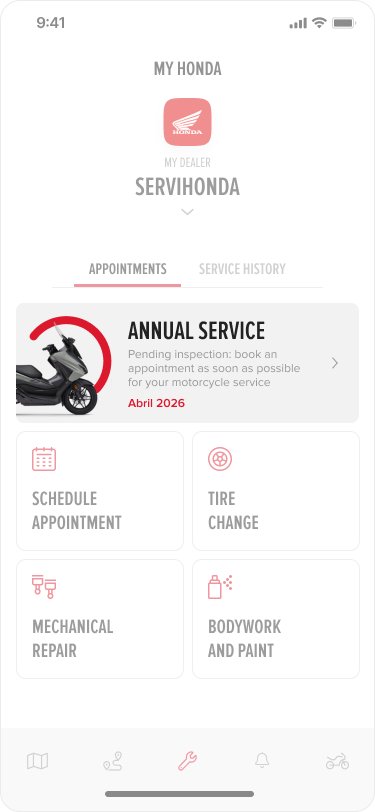
When the service is overdue or immediately due, the card turns red, with urgent copy pushing the user to act and book an appointment as soon as possible.
In all three states, the card is tappable and leads directly to the appointment booking flow, making the path from awareness to action as short as possible.
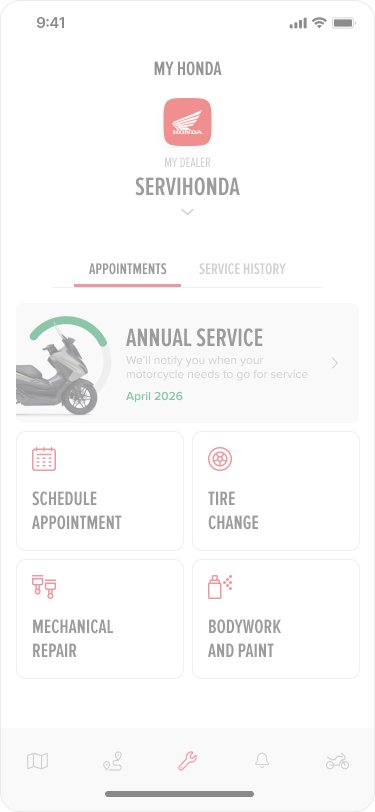
Tapabble card
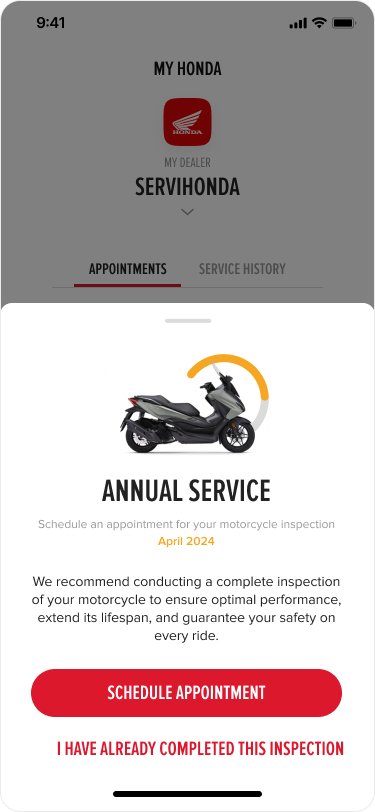
Modal with 2 options: schedule an appointment or log a manual inspection if you’ve already visited the workshop
The entire journey — from notification to confirmed booking — is designed to be completed in under a minute, removing every possible reason to postpone.
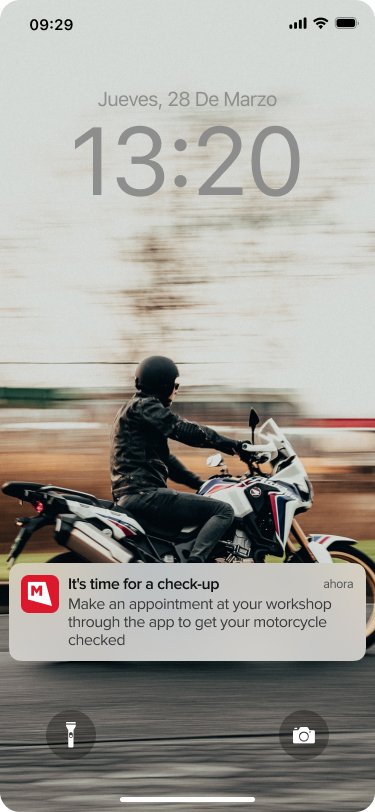
When a user’s service date is approaching, the app sends a push notification directly to their lock screen, prompting them to book an appointment at their Honda dealer.
Tapping the notification opens a bottom sheet modal inside the app. From there, the user has two options: schedule an appointment, or confirm they’ve already had the service done elsewhere.
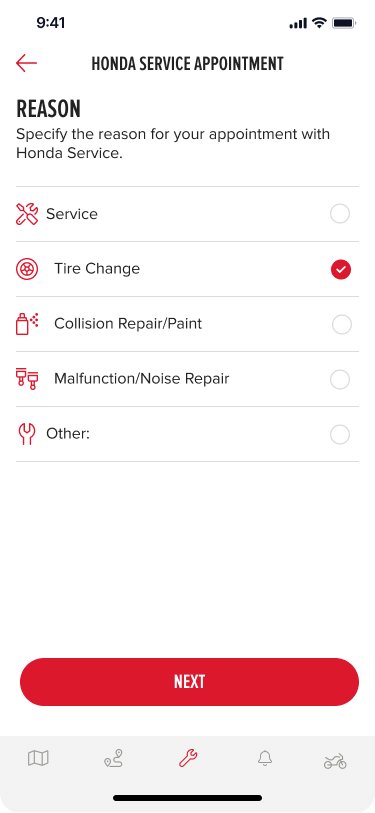
If they choose to book, they’re taken into the appointment flow
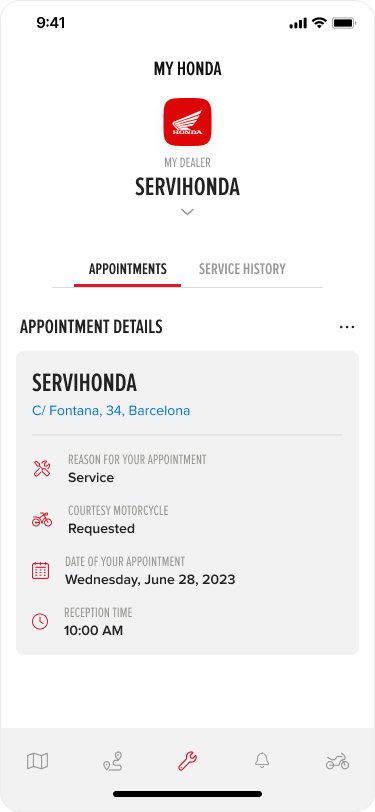
Once requested, the appointment summary screen shows all the booking details in one place, giving the user a clear record of what’s been arranged
¿Want to take a look at the entire feature flow?
We defined two clear, measurable business metrics with a short time horizon to validate the feature’s impact directly and without ambiguity.
The choice of these two metrics is deliberate: the first measures user activation within the app — does the feature actually get people to log their history? The second measures real business impact for Honda. If both are met, the cycle is working.
Users with a maintenance record logged
We increased the amount of tracked users from 30% to 50%
Workshop appointments booked via app
Comparison (pre-launch) 1,023 appointments in February → 2,500 in March (post-launch)
Dropping mileage-based alerts was the right call for this version of the feature — but it won’t be a permanent limitation.
Mapit’s newer hardware devices connect to the motorcycle via CAN bus, the same communication network the bike uses internally to exchange data between its electronic components. Unlike the previous generation of devices, which could only track GPS position and vibrations, these new units can read real-time data directly from the motorcycle — including the actual odometer reading.
Once this data is available across a significant portion of our user base, we’ll be able to layer mileage back into the forecast logic, making the reminders not just time-based, but truly accurate to how each rider actually uses their bike.